

Your backstage pass

View Wins GOLD Edison Award!
View Receives the Gold Edison Award for Innovation in Energy and Sustainability […]

View, Inc.
View Wins GOLD Edison Award!
On Thursday April 5th, in New York City, we were honored to receive the Gold Edison Award for Innovation in Energy and Sustainability.
The Edison Awards, part of the non-profit Edison Universe, seek to highlight ground-breaking technology and innovative companies that are using technology to make the world a better place for all. View’s Dynamic Windows were recognized for allowing in natural light while enhancing physical well-being by significantly reducing headaches, eyestrain and drowsiness, in addition to improving the energy efficiency by 20 percent.
It was an outstanding event, and a notable win for View.
Congratulations to everyone at View!
You can read more about the awards on Entrepreneur.com, or see see all the winners, and learn more about the Edison Awards here.

Atlanta’s Newest Class A Office Space, The Interlock, Features Smart Windows from View
View windows will let in the optimal amount of natural light and preserve views while blocking unwanted glare and heat [...]

View, Inc.
Atlanta’s Newest Class A Office Space, The Interlock, Features Smart Windows from View
View windows will let in the optimal amount of natural light and preserve views while blocking unwanted glare and heat
Developer S.J. Collins Enterprises has chosen to outfit The Interlock, Atlanta’s newest mixed-use development project with Class A office space in the emerging West Midtown neighborhood, with View Dynamic Glass.
“The Interlock is 85 percent leased for its office space component, and we believe that is due to our commitment to providing the best in amenities, open space and design for residents, visitors and office workers,” said Jeff Garrison, a partner at S.J. Collins Enterprises. “We are excited to offer the first building in Atlanta with these high-tech windows that will enhance the occupant experience within the space.”
Scientific research has proven View’s smart windows enhance mental and physical wellbeing by significantly reducing headaches, eyestrain and drowsiness and studies show significant gains in productivity as a result. In addition, they control heat and glare, which improves the energy efficiency of buildings by up to 20 percent.
“Choosing View Smart Windows allows us to create a new type of office environment that will dramatically improve productivity with big open spaces that feature the floor-to-ceiling windows,” said Garrison. “In a tight market, it’s amenities like this that allow us to be successful and attract high-profile clients who are looking to take their office environment to the next level.”
Garrison was familiar with View Dynamic Glass from his experience on the board of the Mount Vernon Presbyterian School, which had also chosen to use View’s smart windows.
“The View Smart Windows ensure education spaces at Mount Vernon Presbyterian School have ample natural light and access to views, which has been shown to improve student performance,” said Garrison.
The commercial office component of The Interlock is currently pre-leased by a 50,000-square-foot space for Georgia Tech and a 120,000-square-foot lease for WeWork.
Located at the corner of Howell Mill Road and 14th Street, The Interlock is expected to offer 200,000 square feet of creative office space, 100,000 square feet of retail space, 345 apartment units and a rooftop view of the city’s skyline, representing approximately $245 million of new development. The Interlock is scheduled for completion in 2020.
Other properties with View Dynamic Glass in the Atlanta area include the AC Hotel Buckhead Plaza. For more information, view this video.
Developer: S.J. Collins Enterprises
Architect: Wakeield Beasley Associates Architects
Glazing Contractor: Jones Glass Inc
Consultant: American Community Builders LLC

Smart glass glare control performance and durability: 2 sides of the same coin
Optimal glare control and visual comfort require 1% Tvis or lower that remains durable over time […]

View, Inc.
Smart glass glare control performance and durability: 2 sides of the same coin
Optimal glare control and visual comfort require 1% Tvis or lower that remains durable over time
At View, our vision is based around the science that natural light is required to live a healthy and productive life. For too long, people have been living indoors with problems like heat and glare while missing out on things our bodies and minds crave — natural light and beautiful views.
View is committed to delivering a smart window system that maintains visual comfort with optimal glare control in even the most challenging daylight conditions – for the life of your building. That’s why we offer smart windows that blocks over 99% of visible light under direct sunlight conditions.
When it comes to investing in smart windows, customers want peace of mind knowing they will provide complete glare control that lasts. Both the performance and durability of the product need to be evaluated to guarantee the right windows are chosen. While industry test methods, such as ASTM E 2141, help ensure smart glass meets basic performance levels, they do not certify it provides optimized visual comfort. Without durable visible light transmission, glass that meets ASTM E 2141 could begin testing at 1% Tvis and exit testing at 6% Tvis – well over the glare control threshold. On the other hand, a product might have great durability but will fail to provide optimal glare control and visual comfort because it cannot reach visual transmission levels below the 1% Tvis threshold for glare.
In this newly released white paper, the ability of View Dynamic Glass to maintain visual comfort in different climate zones with varying daylight conditions was explored. In addition, the study looked at the relationship between visible light transmission (Tvis) and visual comfort for different climates as well as the importance of achieving 0.5% to 1.0% visible light transmission to control direct sunlight. The results demonstrate the optimal Tvis level required to control glare and why simply meeting industry standards might not be enough.
The study
To demonstrate the sensitivity of visible light transmission and glare control, a daylight analysis was performed for a typical south-facing office building in three U.S. locations: Boston, MA, Dallas, TX, and San Francisco, CA. These locations were selected to represent a range of climates and latitudes. Four visible light transmission levels were studied (0.5%, 1.0%, 2%, and 3% Tvis), and annual glare analysis was performed for two desk locations behind the south facade. Daylight Glare Probability (DGP), a metric that quantifies discomfort due to glare, was calculated for each hour of the year for the two desk locations.
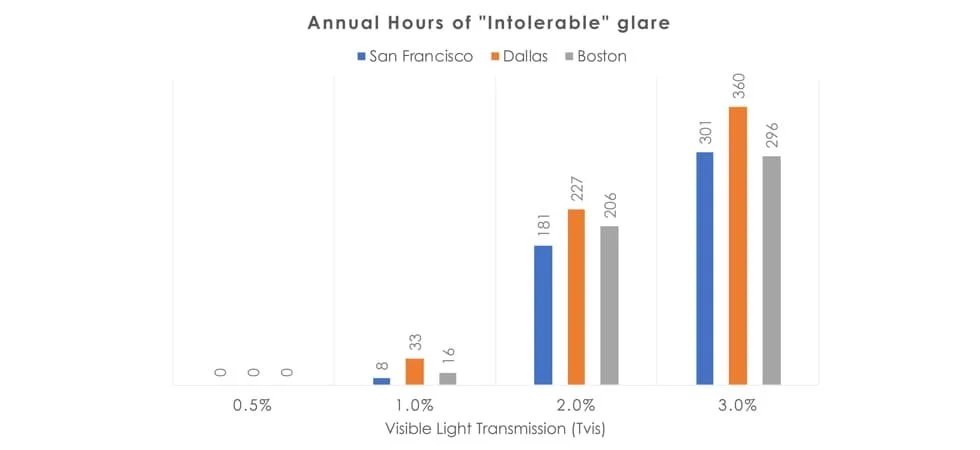
The results: 1.0% Tvis or lower required for complete glare control
The results of the study demonstrate that a 1.0% or lower visible light transmission is required to reduce or eliminate intolerable glare to acceptable levels. Climate, desk position, and visible light transmission of the glazing all play influential roles in determining glare mitigation and visual comfort in a workplace environment. However, the differences seen in climate and desk position are relatively minor compared to the differences in comfort due to visible light transmission. A 2% or higher visible light transmission produced an unacceptable frequency of intolerable glare for desk locations within 10 feet from the facade.
In our quest to improve occupant delight, View Dynamic Glass responds to all sources of glare using its dynamic tint states and predictive Intelligence control system. Even then, it is never advised to look directly at the sun, just the same as when wearing sunglasses outside or viewing a solar eclipse without special glasses.
Download the complete study here.
For more information on the requirements for lasting glare control and ASTM E 2141, download the eBook here.
A Brief History of the Window and a Preview of Its Future!
What is the purpose of the window? The answer seems obvious: to let in light. […]
View, Inc.
A Brief History of the Window and a Preview of Its Future!
What is the purpose of the window? The answer seems obvious: to let in light.
Let’s try an exercise: assuming it is daytime – look out of your nearest window. What do you see? If you are in most work spaces – there is a 60% + chance you will see blinds or shades blocking your view. Not a window with a view, and most definitely not natural light or the view to the outdoors.
The first recorded windows date back to the 13th century BC and were openings in the roof of dwellings to allow in natural light. Over time, these openings had coverings – many opaque, such as shutters. Yet as you look through history, materials such as paper, parchment, animal skin, and finally glass, were used to get the benefit of an open window without exposure to the elements. Humans are wired to be connected to the outdoors – even when the natural elements are not-so-friendly, such as cold, rain, heat, and glaring sun.
Humans not only want natural light, we need it for our health and wellness. Yet in modern times, we spend 90% of our time indoors – and often barricade ourselves from natural light and views of the outdoors with closed blinds. Workplace research shows the optimal amount of natural light that is free from glare reduces eyestrain by 51%, headaches by 63%, and drowsiness by 56%. It should come as no surprise that employees want more natural light – making it the top requested work perk. To take this a step further, 68% of employees say they would feel more valued if their employer considered providing the optimal amount of natural light in the workspace as a core amenity.
Going back to our history lesson – historically glass windows were not easy to create. In Alexandria, Egypt, the first recorded evidence of glass windows dated from 100 AD. Yet they had poor visibility and research showed they were nothing more than blown glass that was rapidly flattened out to make a window. It took another thousand years for glass windows to move forward in any significant way.
Strikingly, hundreds of years more would go by until the next great advance of the window. Meanwhile people continue to suffer through all the imperfections of the humble window – adding blinds, shades and all kinds of workarounds to make up for its shortcomings.
View took a Silicon Valley approach to challenge the way we think about the window. Why couldn’t they be smarter?
View Dynamic Glass windows let in the optimal amount of natural light and preserve views, while blocking unwanted glare and heat, which also improves the energy efficiency of buildings up to 20%.
A smart window is only as smart as its control system. For maximum occupant comfort, windows always need to be at the right tint without requiring manual intervention. That is why View invented the first and only predictive control system for dynamic glass, View Intelligence®. With Intelligence, your windows respond predictively with no occupant intervention, meaning occupants enjoy the views and daylight without lifting a finger.
With a recent major upgrade to Intelligence, our focus on occupant delight has never been so clear. Providing better predictive intelligence and increasing user control and customization makes a delightful space even more delightful.
The next big thing in building occupant experience is here - no blinds or shades required!

10 Years at View
Today marks my 10-year anniversary with View, but in a lot of ways it feels like day one. I’m proud of what we’ve achieved so far, and I’m even more excited about our future. […]

Rao Mulpuri, CEO, View, Inc.
10 Years at View
Today marks my 10-year anniversary with View, but in a lot of ways it feels like day one. I’m proud of what we’ve achieved so far, and I’m even more excited about our future.
Looking back, we started with a simple idea: transform a day-to-day object, the window, to create delightful building environments that improve the health and wellness of the people inside. Along the way we’ve solved extremely difficult materials science and engineering challenges, developed the digital control system, software and apps, built and scaled the most advanced dynamic glass factory in the world, and created a new market category. We are also helping transform real estate, an extremely risk-averse industry, by challenging long held assumptions.
Those efforts have helped us progress from a postage stamp-size electrochromic device in 2008 to View being installed in over 35 million square feet today, with hundreds of thousands of people experiencing better environments every day. On the road to get here we’ve had a lot of success and faced many challenges. This journey has only been possible because of the amazing team at View. They have the intelligence and grit to do what needs to be done and the pride in seeing it completed. I am grateful every day to work with them.
But change is constant, and great companies don’t stand still. In the future, we will aggressively expand our delivery of game changing health and wellness outcomes and energy saving benefits of View while also working on a series of AI-rich applications for smart buildings that take those benefits to the next level.
That future is already here. View SmartProtectTM, the first of several IoT solutions that make buildings healthier, smarter and more productive was released last month.

With the journey already underway, today we see it fitting to announce the evolution of our brand from viewglass.com to view.com, which better reflects our transformation from a dynamic glass supplier to a company creating delightful human environments that are more intelligent, connected and personalized than ever before.
On behalf of all the talented and committed employees at View, welcome to day one of the future.