
Your backstage pass
New Report on the Financial Case for High Performance Buildings -- Why It Matters
The decision to occupy a high-performance building can increase a tenant’s profits by millions during the course of a standard 10-year lease, according to a new report “The Financial Case for High-Performance Buildings” from real estate advisory firm stock. […]
View, Inc.
New Report on the Financial Case for High Performance Buildings -- Why It Matters
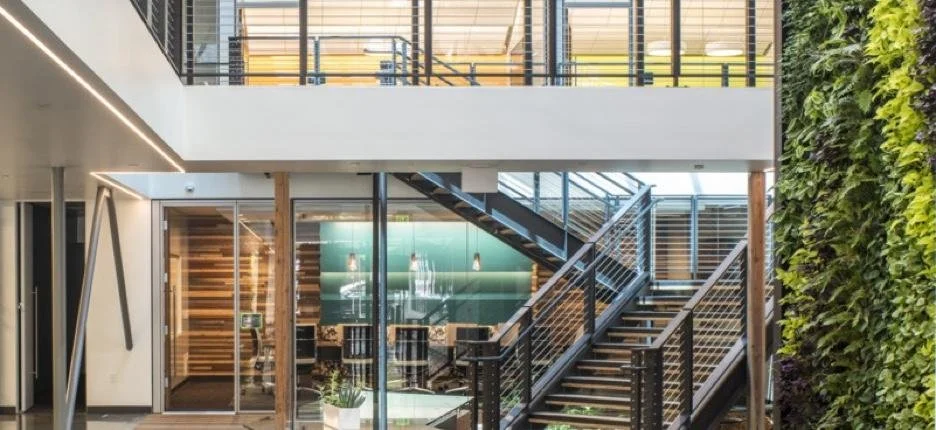
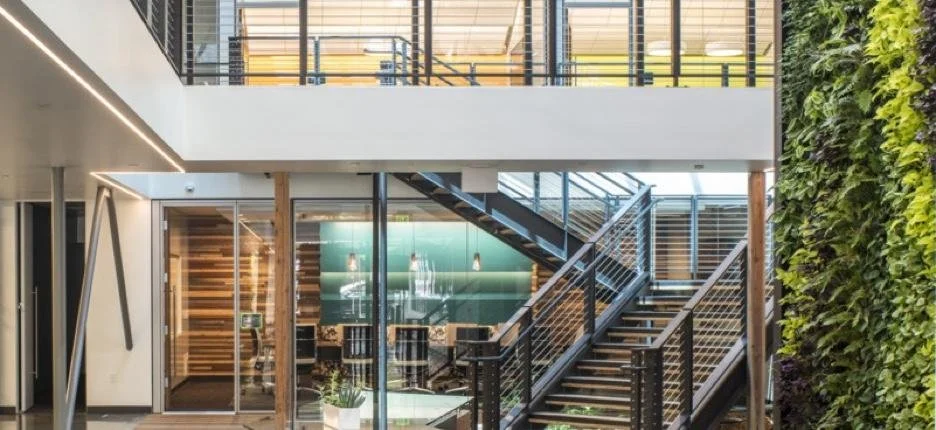
The decision to occupy a high-performance building can increase a tenant’s profits by millions during the course of a standard 10-year lease, according to a new report “The Financial Case for High-Performance Buildings” from real estate advisory firm stock. This profit comes from increased retention, more productivity, and reduced absenteeism.
Supported by hundreds of research studies from leading experts, the paper aims to help owner-occupants and tenants track and quantify the benefits of investing in High-Performance Building (HPB) workplaces. As defined by the report, high-performance buildings are those that are designed to improve the occupant experience and improve health and wellness.
These buildings have design elements to optimize thermal comfort, light, air quality, acoustics, and views of nature or natural materials. For example, View Dynamic Glass, a new generation of smart windows let in natural light and views and enhances mental and physical wellbeing by significantly reducing headaches, eyestrain and drowsiness.
Traditionally, the business case for HPBs depended on energy savings and increased asset value as the most appealing incentives. But a much more important avenue of value creation that HPBs deliver is rarely discussed: HPBs benefit the people who occupy them, which in turn can greatly boost company profit.
Why? Because people are a company’s greatest asset. A HPB workplace that enhances their performance and experience can produce a significant positive impact on the business's bottom line. With employees spending nearly 2,000 hours per year at the office, a workplace that fosters productivity, happiness, and wellness is paramount.
Companies have realized that to attract and retain top talent, a workplace aligned with boosting occupant wellness is required and in turn, produces significant positive impacts on a company’s bottom line.
It should be noted that while employee experience is key, the benefits of HPBs extend to materials and resources as well. Real estate is by far the dominant financial asset class globally, worth nearly 3 times the world’s GDP. At the same time, buildings account for over 40% of U.S. and E.U. energy consumption, use nearly 14% of all potable water, and create over 500 million tons of construction and demolition debris in the U.S. alone. Beyond these financial and environmental impacts, humans spend 90% of their lives indoors.
Key Findings
So how can we quantify the benefits of these human-centric HPB design strategies? In the paper, stok applies financial impact calculations to findings from over 60 robust research studies on the effect of HPBs in three key occupant impact areas: Productivity, Retention, and Wellness. In short, stock's sensitivity analysis found that a conservative estimate of 3% enhancement in productivity, 5% increase in retention, and 30% reduction in absenteeism can be realized in an HPB.
Given this, in a 150,000 square foot HPB when enhanced productivity, increased retention, and improved health are accounted for, the occupier of this space is likely to see a benefit of $3,395/employee, or $18.56/square foot annually in bottom line profit compared to conventional buildings. At a conservative $20/square foot cost premium, a company occupying an HPB can realize a Net Present Value of $17M in profit over 10 years due to improved occupant performance and experience alone.
That is clear, quantified, and impactful value that must be accounted for in the delivery of HPBs and spaces. The question is no longer “How much do HPBs cost?”; now it is “How much can my company benefit by working in an HPB?”
The findings provide concrete evidence for prioritizing design strategies that optimize the indoor environment for enhanced occupant performance and experience. The resulting financial metrics allow owner-occupants and tenants to easily make the business case for High-Performance Buildings.
Download the full report here.
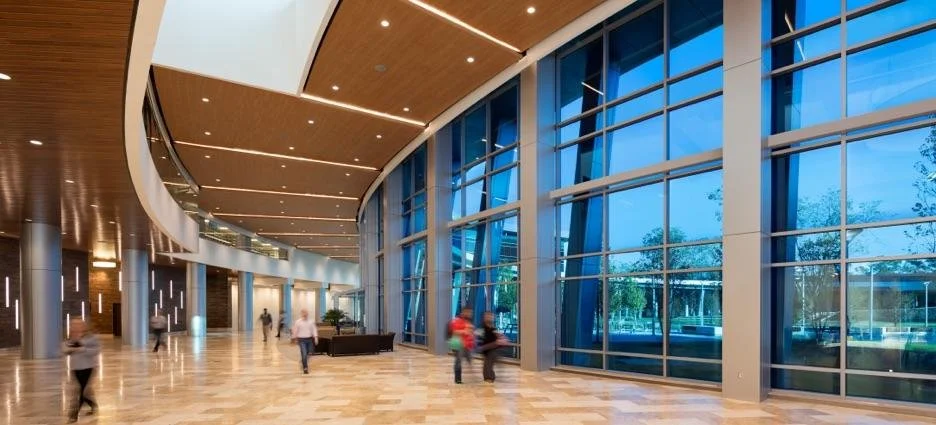
Study: Employees Desire Natural Light and Views Over Any Other Office Perk
I wrote that natural light is increasingly recognized as a significant element in creating a great employee experience. It has the potential to keep employees more energized, more productive, and more engaged. […]
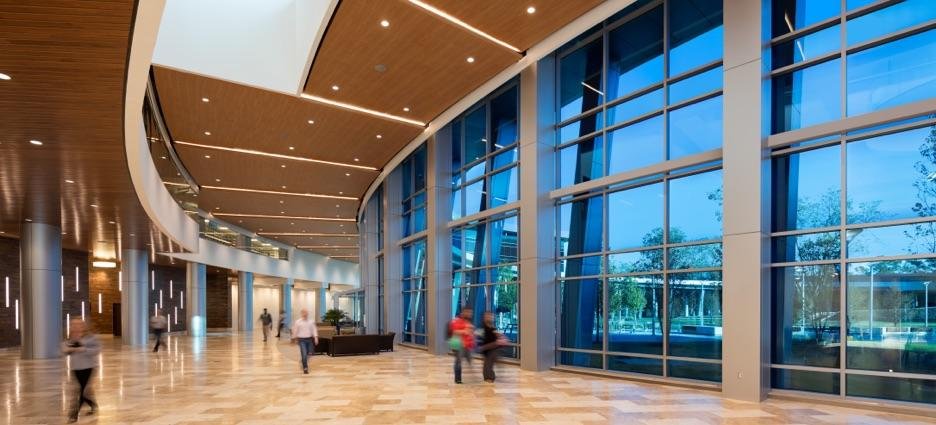
Jeanne Meister - Founding Partner, Future Workplace
Study: Employees Desire Natural Light and Views Over Any Other Office Perk
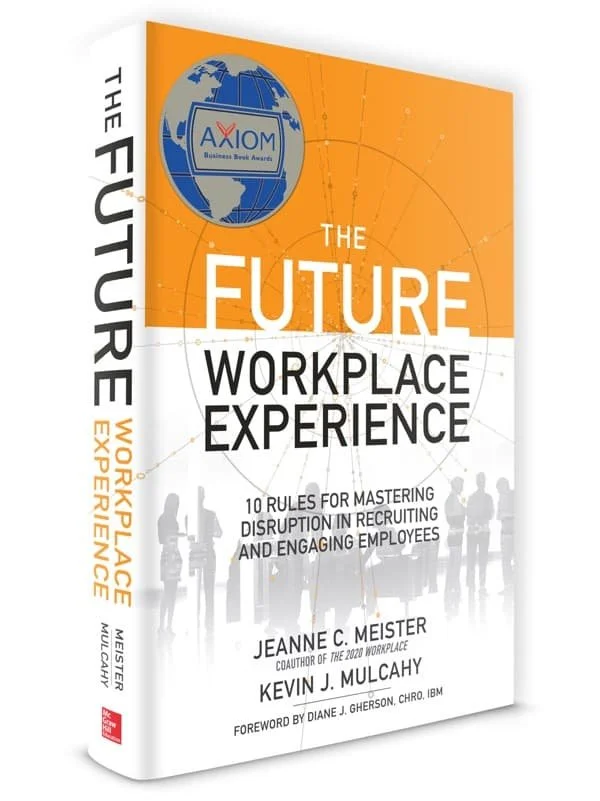
In my 2017 book, The Future Workplace Experience, I wrote that natural light is increasingly recognized as a significant element in creating a great employee experience. It has the potential to keep employees more energized, more productive, and more engaged.
If I was to write that book today, I’d add that as companies increasingly strive to create a great employee experience, placing employees in office spaces with the optimal amount of natural light should be one of their key priorities.
In a newly released study by Future Workplace entitled “The Employee Experience,” over half of the 1,614 North American employees surveyed said natural light and views of the outdoors were their most important office perks, ranking higher than onsite cafeterias, fitness centers, medical care and childcare. Download a summary of the study.
Key findings of The Employee Experience study include:
● Access to natural light and views is a positive factor on the employee experience. Employees say that access to natural light and views improves their overall happiness and well-being (78%), work satisfaction (73%), work performance (70%) and organizational commitment (54%).
● Absence of natural light and views hurts the employee experience. Over a third of employees feel that they don’t get enough natural light in their workspace. 47% of employees admit they feel tired or very tired from the absence of natural light or a window at their office, and 43% report feeling gloomy by the lack of light.
● Prolonged technology use makes employees want a view/natural light more. Over half of employees say that prolonged screen use leads to eyestrain or headaches at work. 73% agree that the longer they use their technology devices, the more they desire a visual break such as taking a walk or glancing at the view outside.
Creating a great employee experience is becoming a business issue attracting the attention of both CEOs and Heads of HR. These findings from “The Employee Experience,” are crucial to providing guidance for HR pioneers who are committed to delivering an exceptional employee experience. These pioneers are leading the way by reaching outside of the HR function to partner with heads of Real Estate, IT, Marketing, Internal Communications, and Global Citizenship to create one seamless employee and customer experience.
New technologies such as View Dynamic Glass are not only fulfilling employees desires to have natural light and views, they are also promoting employee wellness which remains a top concern for human resource leaders. Workers spend on average five hours and 42 minutes at their desk each day. Think of the impact access to natural light could have on their overall work performance, wellbeing and satisfaction. A healthy, restorative workplace is the foundation for a high performing, content and engaged workforce.

About Jeanne Meister
Jeanne Meister is Founding Partner of Future Workplace, an HR Executive Network and Research firm. She is the best-selling author of four books, two books on Corporate Universities and two books on the future of work. Her most recent book is, The Future Workplace: 10 Rules For Mastering Disruption in Recruiting and Engaging Employees. This book was awarded the Silver Axiom Best Business Book Award for Human Resources professionals in 2017 and most recently the receipt of the Bellwether award, by the Community College Futures Assembly. Jeanne is also a Contributor to Forbes and her column can be found here: http://blogs.forbes.com/jeannemeister/.

Three tips to maintain a productive & healthy summer
The summer solstice on June 21st marks the longest day of the year in the Northern Hemisphere and is the unofficial start to our summer season. During the summer, you’re exposed to more hours of sunlight, which is fabulous if you’re on vacation - but can be not so great if you’re sitting in the office with glare and heat beating down on you at your workstation. […]

Vasudha Bisani, Marketing Intern, View Inc.
Three tips to maintain a productive & healthy summer
The summer solstice on June 21st marks the longest day of the year in the Northern Hemisphere and is the unofficial start to our summer season. During the summer, you’re exposed to more hours of sunlight, which is fabulous if you’re on vacation - but can be not so great if you’re sitting in the office with glare and heat beating down on you at your workstation.
More sunlight also means less darkness, which can play havoc with your sleep cycle and affect your overall health and wellbeing. However, when you’re well prepared, midsummer is a great time to start the day early and reap the benefits of more natural sunlight.
Here are 3 tips to enjoy this summer, while staying healthy and productive too:
1. Lighten Up: - While traditional windows let sunlight in, they often come with the uncomfortable side effects of heat and glare. This forces people to shut their blinds or curtains during the day, disconnecting them from nature and the outdoors. However, by investing in a smart windows, you can cut out the unwanted heat and glare and still enjoy the light and views. By avoiding blinds and shutters and letting in optimized light, you’ll be surprised by how much your productivity can improve. According to a study conducted by Cornell Professor Dr. Alan Hedge, workers in office environments with smart windows reported a 51 percent drop in the incidence of eyestrain and a 63 percent drop in the incidence of headaches, both of which can detract from productivity. If you don’t have smart windows yet – or worse – have no windows at all in your office, be sure to frequently step outside and enjoy some sunshine. You will return to work better for it.
2. Stay hydrated during the day: - Drinking plenty of water during the day will help you keep cool and refreshed through the evening. We all know, that coffee or soda can seem so much more delicious; however, caffeine can dehydrate you and further cause sleep disturbances, so be sure to consume them wisely.
3. Exercise Comfortably, even in the heat: - Just because it’s hot outside doesn’t mean you have to stop exercising. Try some different activities like water sports, swimming, or indoor boot camps to avoid the sun when it is the strongest. This will not only keep you healthy, but also improve your efficiency for the day.
Midsummer is a great time to focus on improving your health and happiness by getting closer to nature and celebrate the energy of summer. How are you going to take the advantage of the extra hours of light this year?
Featured Image by: Paul Townsend via Flickr
How Offices Are Turning Windows Into Walls
Recently, we had the opportunity for a creative experiment – we mounted cameras on a building to watch the windows of an occupied office building across the way. […]
Brian Lee – Manager, Product Marketing
Deepak Shivaprasad – Sr. Director, Product Marketing
How Offices Are Turning Windows Into Walls
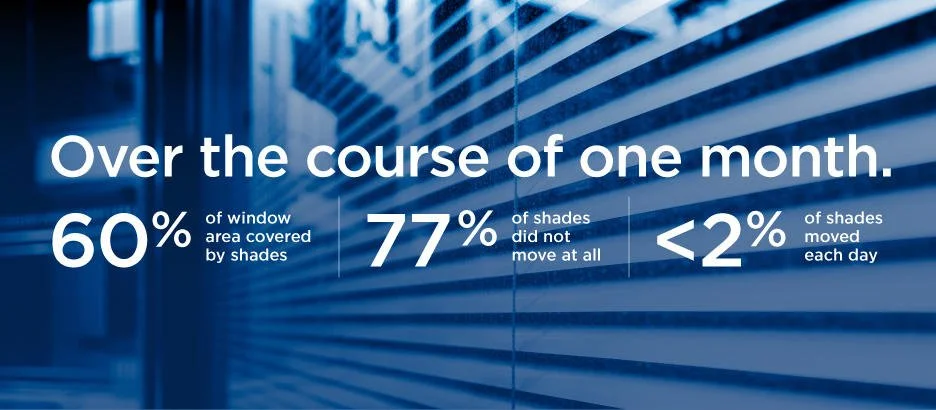
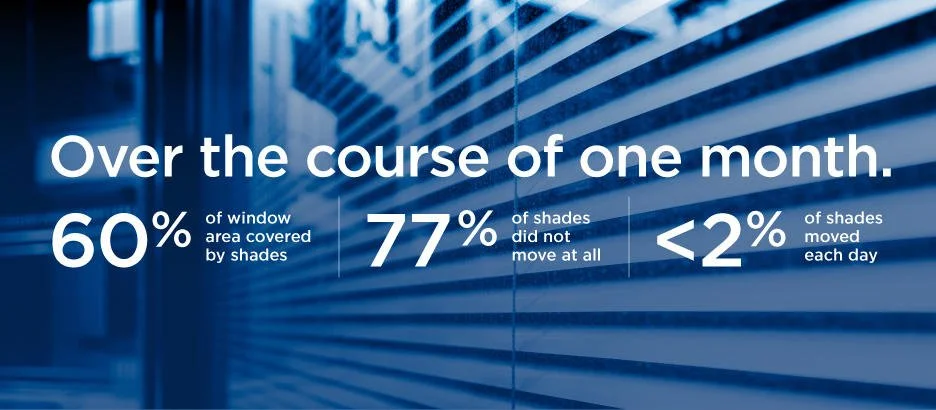
Recently, we had the opportunity for a creative experiment – we mounted cameras on a building to watch the windows of an occupied office building. Building occupants were not informed of the study to eliminate the influence of behavioral changes on the experiment’s outcome. Only the top 3 floors of the building were occupied, but we wanted to see how often the shades were drawn on those floors. The building is in sunny Northern California and has expansive views of the San Francisco Bay. You would expect those windows to be popular - everyone loves windows and a view, right? Until….the heat and glare become too much. Then, down come the shades.
By using time-lapse images taken every 15 minutes and measuring the change in window coverage on the top three floors for a month, here is what we found:
· 60% of the windows were covered by shades.
· 77% of the shades never moved at all.
· Less than 2% of the shades were adjusted daily (on average).
Wow! Once the heat and glare is in the building, people drop the shades – and once they are down, they continue to stay down essentially creating another wall in the office. Nearly 2/3 of the views and natural light are removed with fewer people getting the benefit of the green space and sunlight just outside their office.
Why do we invest in windows if this is the behavior? Because not everyone knows about dynamic glass. Here at View, our mission is to create delightful human environments. Our glass automatically changes tint during the day to control glare, eliminate heat, and optimize daylight in order to make the space visually and thermally comfortable. No shades are needed. Read more about our technology here.

New Research - Dynamic Glass & The Airport Passenger Experience
Earlier this year, we launched the first step of an ambitious human factors research initiative to help us better quantify how dynamic glass impacts productivity, health and wellness in the workplace. […]

Brandon Tinianov - VP, Industry Strategy at View, Inc.
New Research - Dynamic Glass & The Airport Passenger Experience
Earlier this year, we launched the first step of an ambitious human factors research initiative to help us better quantify how dynamic glass impacts productivity, health and wellness in the workplace.
The study found that optimizing the amount of natural light in an office significantly improves health and wellness among workers, leading to gains in productivity and a reduction in the symptoms associated with extended computer work.
Today, we’re sharing the results of our second research study on the impact of natural light on occupant comfort. Instead of limiting ourselves to offices, we studied one of the most hectic environments in modern society – the airport. Our goal was to determine if dynamic glass and improved natural light could enhance passenger experience and comfort in a quantifiable way.
We all know that tug of anxiety that you feel when entering an airport. First, there’s the security line to traverse. Then there’s the time it takes to make your way to your terminal and gate. On top of that there’s the poor acoustics and the inevitable glare of the sun that makes for an uncomfortable wait before your flight. We firmly believe that airports don’t need to increase stress and fatigue.
We’ve partnered with Dallas Fort Worth (DFW) Airport, and an independent aviation market research group to contrast the experiences of passengers in airport gates with traditional windows to passengers in airport gates with intelligent dynamic glass.
Key findings of the study include:
· Seating with a view matters.
Passengers prioritize access to natural light and views of the airfield ahead of proximity restrooms and televisions and even electrical outlets. With dynamic glass installed in fully operational boarding area, 84 percent of passengers sought a seat closest to a window. When asked, passengers preferred the light quality of the dynamic glass 3 to 1 over conventional glass.
· Dynamic Glass increases passenger comfort by keeping the heat out.
Even with moderate outdoor temperatures of 55F, infrared imaging showed dynamic glass reduced surface temperatures up to 15 degrees on seats, carpets, passenger clothing and skin compared to the gate with conventional glass. This improvement in thermal comfort promotes greater passenger delight and enables reduced use of HVAC systems for cooling.
· Passenger comfort translates to longer dwell times.
Survey results found that passengers seated next to dynamic glass stayed 83 percent longer than passengers seated next to conventional glass. Passengers were better able to use devices like smartphones, laptops and tablets without glare or discomfort.
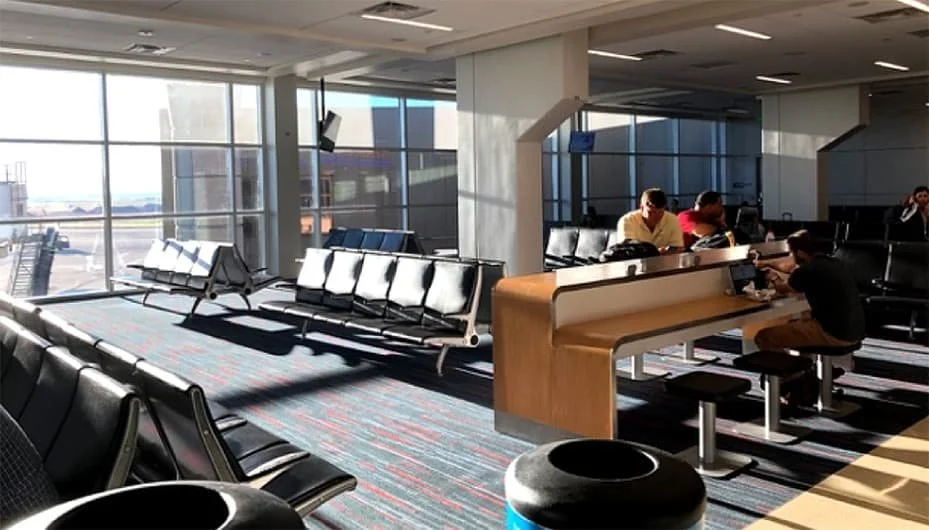
Without View Dynamic Glass (GATE A25: Conventional Glass)

With View Dynamic Glass (GATE A28)
· Improved comfort drives revenue.
In addition to the installation of dynamic glass at an active gate, it was also installed in one of the airport’s busiest restaurants, the Twisted Root. Following the installation, patron and employee comfort significantly increased, leading to additional revenue. In fact, the restaurant saw a 102 percent year-over-year increase in concession sales over a six month period, compared to the same 6 months the year before.
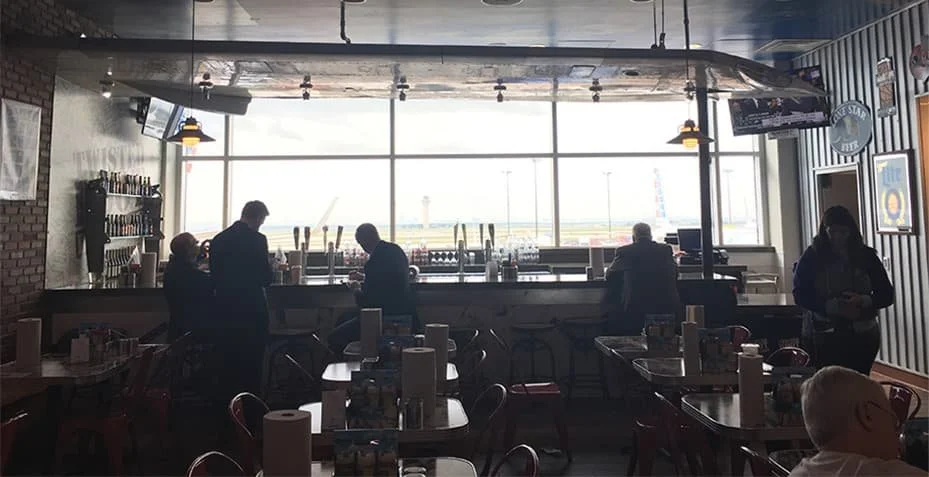
BEFORE: Conventional Glass at the Restaurant
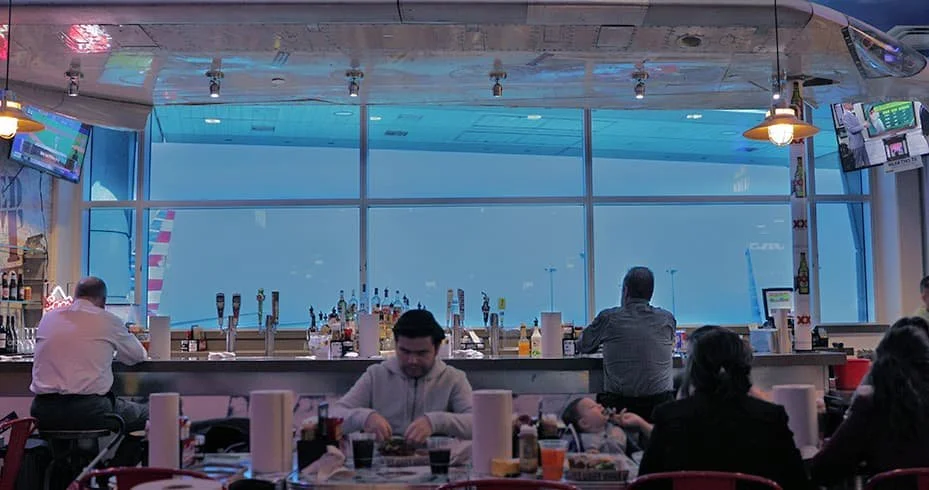
AFTER: With View Dynamic Glass
As you can imagine, we’re encouraged by these findings and believe they validate the already intuitive value dynamic glass provides in the airport passenger experience.
View has installed dynamic glass at several U.S. airports including: Boston Logan International Airport (BOS), Charlotte-Douglas International Airport (CLT), San Francisco International Airport (SFO), and Seattle-Tacoma International Airport (SEA).
There is a lot more to unpack from this study, so be sure to read the full report and stay tuned for more human factors research from View and leading researchers coming soon.