

Your backstage pass

Smart glass glare control performance and durability: 2 sides of the same coin
Optimal glare control and visual comfort require 1% Tvis or lower that remains durable over time […]

View, Inc.
Smart glass glare control performance and durability: 2 sides of the same coin
Optimal glare control and visual comfort require 1% Tvis or lower that remains durable over time
At View, our vision is based around the science that natural light is required to live a healthy and productive life. For too long, people have been living indoors with problems like heat and glare while missing out on things our bodies and minds crave — natural light and beautiful views.
View is committed to delivering a smart window system that maintains visual comfort with optimal glare control in even the most challenging daylight conditions – for the life of your building. That’s why we offer smart windows that blocks over 99% of visible light under direct sunlight conditions.
When it comes to investing in smart windows, customers want peace of mind knowing they will provide complete glare control that lasts. Both the performance and durability of the product need to be evaluated to guarantee the right windows are chosen. While industry test methods, such as ASTM E 2141, help ensure smart glass meets basic performance levels, they do not certify it provides optimized visual comfort. Without durable visible light transmission, glass that meets ASTM E 2141 could begin testing at 1% Tvis and exit testing at 6% Tvis – well over the glare control threshold. On the other hand, a product might have great durability but will fail to provide optimal glare control and visual comfort because it cannot reach visual transmission levels below the 1% Tvis threshold for glare.
In this newly released white paper, the ability of View Dynamic Glass to maintain visual comfort in different climate zones with varying daylight conditions was explored. In addition, the study looked at the relationship between visible light transmission (Tvis) and visual comfort for different climates as well as the importance of achieving 0.5% to 1.0% visible light transmission to control direct sunlight. The results demonstrate the optimal Tvis level required to control glare and why simply meeting industry standards might not be enough.
The study
To demonstrate the sensitivity of visible light transmission and glare control, a daylight analysis was performed for a typical south-facing office building in three U.S. locations: Boston, MA, Dallas, TX, and San Francisco, CA. These locations were selected to represent a range of climates and latitudes. Four visible light transmission levels were studied (0.5%, 1.0%, 2%, and 3% Tvis), and annual glare analysis was performed for two desk locations behind the south facade. Daylight Glare Probability (DGP), a metric that quantifies discomfort due to glare, was calculated for each hour of the year for the two desk locations.
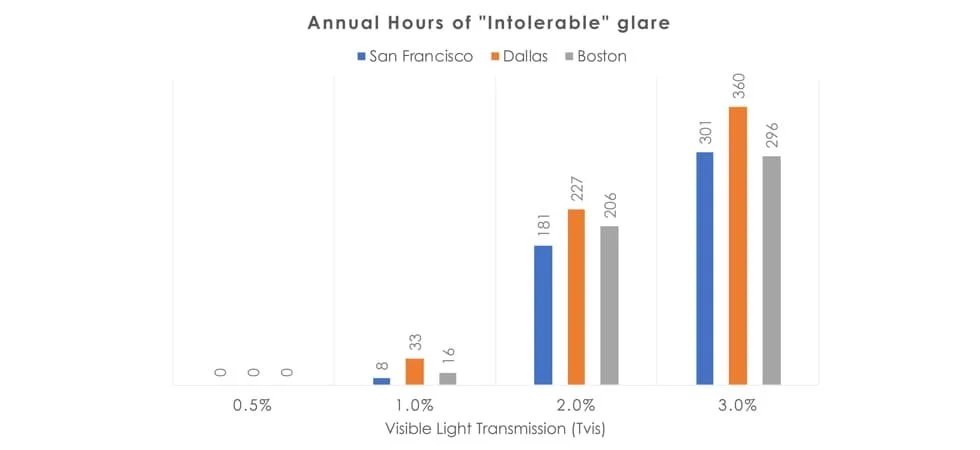
The results: 1.0% Tvis or lower required for complete glare control
The results of the study demonstrate that a 1.0% or lower visible light transmission is required to reduce or eliminate intolerable glare to acceptable levels. Climate, desk position, and visible light transmission of the glazing all play influential roles in determining glare mitigation and visual comfort in a workplace environment. However, the differences seen in climate and desk position are relatively minor compared to the differences in comfort due to visible light transmission. A 2% or higher visible light transmission produced an unacceptable frequency of intolerable glare for desk locations within 10 feet from the facade.
In our quest to improve occupant delight, View Dynamic Glass responds to all sources of glare using its dynamic tint states and predictive Intelligence control system. Even then, it is never advised to look directly at the sun, just the same as when wearing sunglasses outside or viewing a solar eclipse without special glasses.
Download the complete study here.
For more information on the requirements for lasting glare control and ASTM E 2141, download the eBook here.
A Brief History of the Window and a Preview of Its Future!
What is the purpose of the window? The answer seems obvious: to let in light. […]
View, Inc.
A Brief History of the Window and a Preview of Its Future!
What is the purpose of the window? The answer seems obvious: to let in light.
Let’s try an exercise: assuming it is daytime – look out of your nearest window. What do you see? If you are in most work spaces – there is a 60% + chance you will see blinds or shades blocking your view. Not a window with a view, and most definitely not natural light or the view to the outdoors.
The first recorded windows date back to the 13th century BC and were openings in the roof of dwellings to allow in natural light. Over time, these openings had coverings – many opaque, such as shutters. Yet as you look through history, materials such as paper, parchment, animal skin, and finally glass, were used to get the benefit of an open window without exposure to the elements. Humans are wired to be connected to the outdoors – even when the natural elements are not-so-friendly, such as cold, rain, heat, and glaring sun.
Humans not only want natural light, we need it for our health and wellness. Yet in modern times, we spend 90% of our time indoors – and often barricade ourselves from natural light and views of the outdoors with closed blinds. Workplace research shows the optimal amount of natural light that is free from glare reduces eyestrain by 51%, headaches by 63%, and drowsiness by 56%. It should come as no surprise that employees want more natural light – making it the top requested work perk. To take this a step further, 68% of employees say they would feel more valued if their employer considered providing the optimal amount of natural light in the workspace as a core amenity.
Going back to our history lesson – historically glass windows were not easy to create. In Alexandria, Egypt, the first recorded evidence of glass windows dated from 100 AD. Yet they had poor visibility and research showed they were nothing more than blown glass that was rapidly flattened out to make a window. It took another thousand years for glass windows to move forward in any significant way.
Strikingly, hundreds of years more would go by until the next great advance of the window. Meanwhile people continue to suffer through all the imperfections of the humble window – adding blinds, shades and all kinds of workarounds to make up for its shortcomings.
View took a Silicon Valley approach to challenge the way we think about the window. Why couldn’t they be smarter?
View Dynamic Glass windows let in the optimal amount of natural light and preserve views, while blocking unwanted glare and heat, which also improves the energy efficiency of buildings up to 20%.
A smart window is only as smart as its control system. For maximum occupant comfort, windows always need to be at the right tint without requiring manual intervention. That is why View invented the first and only predictive control system for dynamic glass, View Intelligence®. With Intelligence, your windows respond predictively with no occupant intervention, meaning occupants enjoy the views and daylight without lifting a finger.
With a recent major upgrade to Intelligence, our focus on occupant delight has never been so clear. Providing better predictive intelligence and increasing user control and customization makes a delightful space even more delightful.
The next big thing in building occupant experience is here - no blinds or shades required!

View Dynamic Glass - Re-inventing the occupant experience with predictive intelligence
At View, our vision is based around the science that natural light is required to live a healthy and productive life. […]

View, Inc.
View Dynamic Glass - Re-inventing the occupant experience with predictive intelligence
At View, our vision is based around the science that natural light is required to live a healthy and productive life. For too long, people have been living with problems like heat and glare while missing out on things our bodies and minds crave — natural light and beautiful views.
View Dynamic Glass windows let in the optimal amount of natural light and preserve views, while blocking unwanted glare and heat, enhancing mental and physical wellbeing by significantly reducing headaches, eyestrain and drowsiness. In addition, controlling heat and glare also improves the energy efficiency of buildings up to 20%.
A smart window is only as smart as its control system. For maximum occupant comfort, windows need to be at the right tint at all times without requiring manual intervention. That is why, in 2012, View invented the first and only predictive control for dynamic glass, View Intelligence®. With Intelligence, your windows respond predictively with no occupant intervention, meaning occupants enjoy the views and daylight without lifting a finger.
In our quest to improve occupant delight, we are proud to announce the most significant update ever to Intelligence. This third generation of Intelligence includes key advances in cloud detection, prediction of reflections from surrounding buildings, and external obstruction modelling. The result: even more daylight and views for indoor spaces, while continuing to minimize glare and thermal discomfort. Occupants will be healthier, happier and more productive than ever.
In addition, we have made several improvements to the user interface, providing occupants more intuitive capabilities to personalize spaces to their own unique needs. This includes new mobile apps for Android and Apple iOS, a new web interface, and the View Touch Display, a wall mounted user interface.
We spend 90% of our time in buildings, and View is on a mission to make that time better. With this new release of Intelligence, our focus on occupant delight has never been so clear. Providing better predictive intelligence and increasing user control and customization makes a delightful space even more delightful.
The next big thing in building occupant experience is here.
Find out more here.

View Selected as a SXSW Interactive Innovation Awards Finalist
It’s that time of year again- SXSW is finally upon us. And as The Valley makes its annual pilgrimage to Austin later this week, we here at View couldn’t be more excited to announce that View Intelligence has been selected as a finalist in the Smart Cities category for the 19th annual SXSW Interactive Innovation […]

Jeff Platón - VP, Marketing
View Selected as a SXSW Interactive Innovation Awards Finalist
It’s that time of year again- SXSW is finally upon us. And as The Valley makes its annual pilgrimage to Austin later this week, we here at View couldn’t be more excited to announce that View Intelligence has been selected as a finalist in the Smart Cities category for the 19th annual SXSW Interactive Innovation Awards.
We’re particularly honored to be recognized by SXSW because this award highlights innovations in eco-friendly or sustainable energy, transportation, and IoT technology, making life in the connected world a smarter, cleaner, greener, and more efficient Internet of Everything. (All things we believe in deeply.)
View will also be part of the first annual March 14 Finalist showcase, open to anyone with an Interactive, Gold, or Platinum SXSW badge.
We’re happy to join other leaders in IoT to celebrate the most inspiring, creative innovations in the connected world, during the March 15th ceremony where award recipients will be announced along with winners in each of the 13 award categories, the winner of the David Carr Prize for Emerging Writers and recipients of the five special honors – Best of Show, People’s Choice, Breakout Trend of the Event, Speaker of the Event, and Meme of the Year.
If you’re attending the event, swing by the Finalist Showcase to see View Dynamic Glass in action, and if you can’t join us in person, follow View on Twitter for live updates from SXSW Interactive.

View Wins Product Innovation Award
Our team has been working diligently to create a modern solution for windows that provides increased architectural freedom, energy efficiency, and general wellness. We are happy to share that our ongoing efforts to bring smart glass into the mainstream were recognized in last month’s issue of Architectural Products magazine. Top industry professionals selected View Dynamic […]

Brett Murray - Vice President, Marketing
View Wins Product Innovation Award
Our team has been working diligently to create a modern solution for windows that provides increased architectural freedom, energy efficiency, and general wellness. We are happy to share that our ongoing efforts to bring smart glass into the mainstream were recognized in last month’s issue of Architectural Products magazine. Top industry professionals selected View Dynamic Glass as a 2014 Product Innovation Award (PIA) winner in the “Glazing and Openings” category.
We’re excited to see continued industry validation of View Dynamic Glass. It also was recognized as a technologically advanced and energy-efficient product in the U.S. Green Building Council’s first annual Best of Buildings Awards earlier this year.
Since our first installation in 2012 at the W hotel in San Francisco, we’ve engaged in over 145 projects in North America with applications across education, hospitality, healthcare, and the workplace. Organizations such as SAP, Hilton Hotels, NASA, Kaiser Permanente, CenturyLink and Southern Methodist University have incorporated View Dynamic Glass into their building designs.
We are honored to receive this award and look forward to many more exciting projects.
Click here for details about the award on page 76 of the November online issue of Architectural Products magazine.